A critical CVE lands in your backlog. It’s one of thousands sitting in your SCA queue, and severity alone tells you almost nothing about what to do next.
Is the vulnerable function actually reachable in your code? Is it exploitable in your specific application context? Is there a fix version, and if not, what’s your mitigation path? And if there is a fix, will upgrading the package break your build, your tests, or half your production integrations?
Every one of those questions used to require a security engineer and/or developer to stop, analyze, and struggle through. Most teams don’t have the time, so they either ignore the backlog or upgrade blindly and hope nothing breaks. Neither is a strategy. It’s a losing bet against intensifying threats and increasing CVE volume even as teams work harder to bring them down.
Cycode closes that gap end-to-end. Triage risk with real context, choose the right remediation strategy for the vulnerability in front of you, and arm coding agents with the context to fix it without introducing breaking changes.
Triage exploitable risk first
Severity and CVSS score were never designed to tell you whether to fix something today. They say nothing about whether the vulnerable code path is reachable in your application, whether an exploit exists in the wild, or what it would actually cost the business if it were hit.
Cycode SCA replaces severity-based triage with risk analysis that accounts for the full picture:
- Risk scoring beyond CVSS: Threat intelligence, EPSS-style exploit likelihood signals, and business impact all factor into a violation risk score that goes beyond severity.
- Reachability analysis: Cycode determines whether the vulnerable function is actually called in your code, cutting out the noise from dependencies that are present but never invoked.
- Exploitability analysis: The AI Exploitability Agent goes further, reasoning across application context to confirm whether a CVE or CWE is genuinely exploitable in your environment, not just theoretically vulnerable.
This is Context in action. The Context Intelligence Graph correlates CVEs with code paths and deployment context, so the violations that rise to the top of the queue are the ones actually worth a developer’s time and token budget.

Minimize exposure to exploitable vulnerabilities
Once you know a violation is an exploitable risk worth fixing, the next fork in the road is simple. Does a fix version exist?
If there’s no fix version yet, upgrading isn’t an option, so the goal shifts to reducing exposure. That can mean applying compensating controls at the pipeline or runtime layer, or moving to a hardened, pre-patched image. As a member of the Athena coalition for open-source security, Cycode provides safe, non-breaking versions of vulnerable packages while the upstream fix is in flight. However, a backported patch or a hardened fork doesn’t resolve the CVE. It reroutes around it by diverging from the package your code actually depends on. This is a reasonable stopgap but not a complete long-term strategy. Every new CVE adds another layer to patch, and the debt compounds until the real upgrade can’t be deferred. By then, it’s often a bigger jump than if you’d handled it version by version.
If a fix version exists, the question changes entirely. How much will upgrading actually cost you? This is where most teams get stuck. Upgrading open source packages has always carried a hidden tax: nobody knows how much refactoring a version bump will trigger until someone attempts it, and by then it’s too late to plan around. Upgrade Impact Analysis removes the guesswork and puts you on a fast track to remediate without breaking changes.
Accelerate remediation with Upgrade Impact Analysis
For CVEs with a fix version, Upgrade Impact Analysis inspects how your codebase actually uses the vulnerable package and compares the source version against the destination version across three dimensions:
- Function changes: Which functions your code calls have been removed or had their signatures changed between versions, so you know exactly how much intervention the upgrade needs.
- Change surface: How many files and call sites are affected, and whether that impact is concentrated or spread across core logic.
- Peer dependencies: Whether other packages need to move in lockstep for a compatible version set.
What comes back is a verdict with an upgrade effort rating of No, Low, Medium, or High Impact, paired with a confidence score so teams know how much to trust it. Alongside the verdict sits a plain-language summary, code-level evidence pointing to the exact files and snippets driving the score, and a remediation plan for medium and high impact violations with the specific steps for a safe, non-breaking upgrade.
That output isn’t just for a human to read and act on manually. It’s structured to hand directly to a coding agent as a prompt, spelling out what changed, where, and what needs to happen next. That’s the same principle behind Cycode’s AI Fix & Remediation Agent, which already turns confirmed findings into PR-ready diffs. Upgrade Impact Analysis extends that same idea specifically to the hardest class of SCA fix, the one where the upgrade itself might be the thing that breaks production.

Put it all together for agentic SCA remediation
Strip away the individual capabilities, and the workflow is straightforward:
- Filter for violations that matter using reachability and context, not raw severity. Further refine by whether there is a fixed version.
- Analyze for exploitability to confirm the risk is real before anyone spends time on it.
- Generate a remediation strategy. Mitigate and track safer versions if there’s no fix yet; run Upgrade Impact Analysis if there is.
- Execute the fix with a coding agent armed with real context, an upgrade impact verdict, evidence, and a concrete plan, instead of a version number and a vague prompt.
Each stage removes an obstacle where teams used to stall. Teams no longer have to guess at what’s urgent, what’s exploitable, whether a fix is safe, or how to actually make the change. Cycode reasons across all four, minimizing your exposure to exploitable vulnerabilities. Agentic Workflows trigger the process the instant risks appear, delivering answers faster than teams used to start investigating.
Close the CVE exposure window
The goal was never to generate another finding. It’s to shrink the time between an SCA scan finding a high-risk CVE and remediated code with no breaking changes. Reachability and exploitability analysis tell you what’s real. Mitigation and safe-version options tell you how to buy time. Upgrade Impact Analysis accelerates the path from found risk to functional fix.
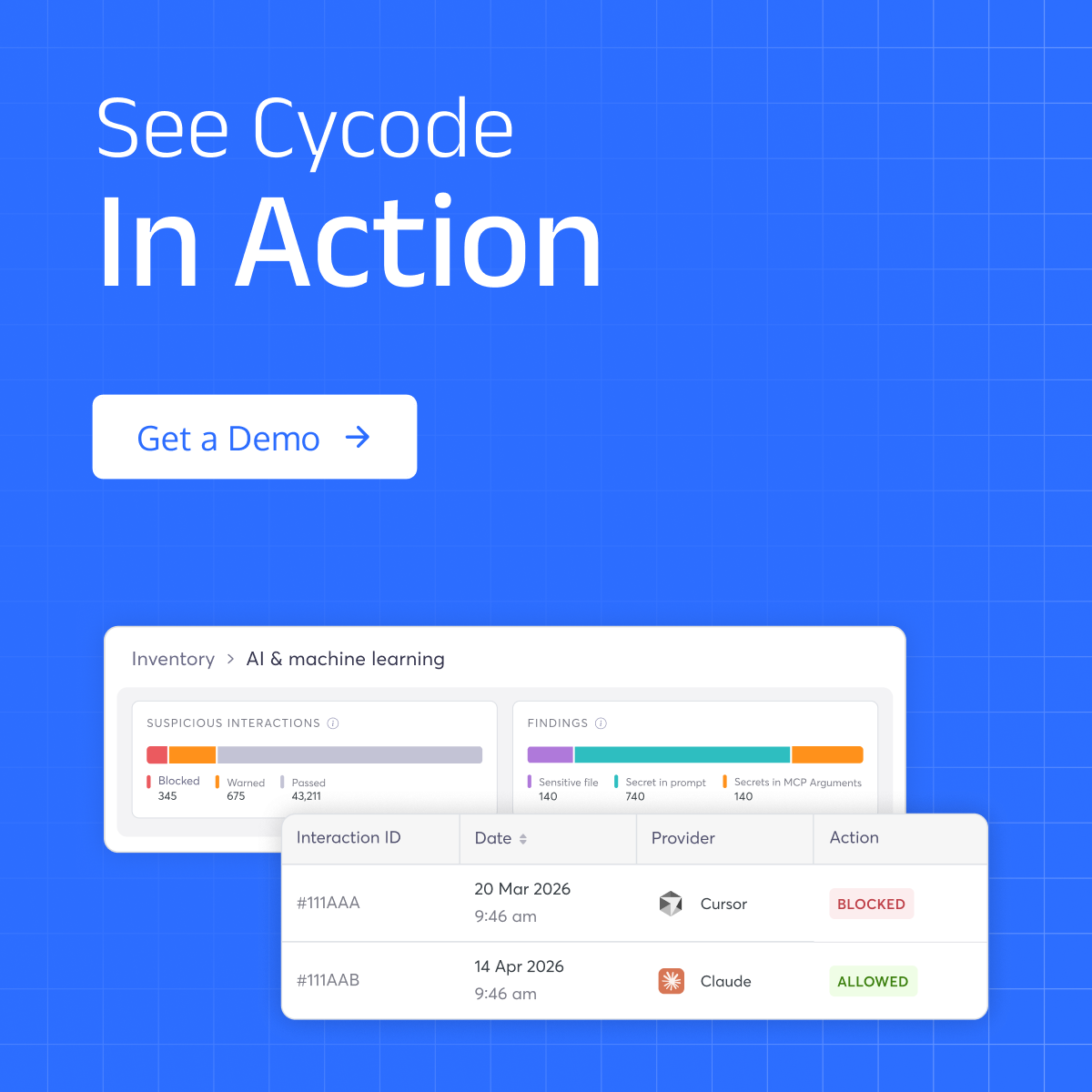
Ready to see it in action? Get a demo of Cycode SCA, Exploitability Analysis, and Upgrade Impact Analysis today.