


Security has a math problem humans can’t solve.
Agentic development introduces risk faster than people can manage it. AI generates, discovers, and exploits vulnerabilities at machine speed. The attack surface is expanding. Threats are intensifying. Risk is increasing. But security remains constrained by human-driven operating models.
Today, that changes.
Agentic Workflows eliminate human constraints without surrendering human control by putting agents to work for security, instantly and automatically, executing workflows you define within boundaries you set.
Put simply, Agentic Workflows make security as agentic as development.
Advancing Agentic Security from “Human-Driven & Agent-Assisted” to “Agent-Driven & Human-Controlled”
AI for security started with discrete capabilities to assist humans with the traditional software development lifecycle. Cycode introduced AI Teammates that security engineers and developers could invoke to fix a violation, analyze for exploitability, identify the impact of code changes, and query the graph database. Next, we introduced Cycode Maestro, a multi-agent orchestrator that can execute complex tasks like analyzing exposure or fixing exploitable vulnerabilities within a repository.
When we analyzed 500 Maestro conversations to see how security teams actually use agents day to day, we saw them unlock high-value use cases, increase remediation capacity, and alleviate human workloads. However, we also saw limitations and opportunities. Even with AI assistance, people had to prompt Maestro to act or explicitly invoke agents.
While prompts and chats are effective for certain use cases, managing risk at the speed and scale of agentic development (and reducing exposure windows in parallel with a rapidly shrinking time to exploit) requires instant and automatic agent actions bounded by controls. That is what Cycode delivers with Agentic Workflows.
How Agentic Workflows Work
Every workflow has a trigger condition, an ordered sequence of agent actions, and the human controls governing each step. Define it once, and workflows run automatically when events trigger them, chaining agents together to run vulnerability triaging and remediation without requiring humans to initiate the process.
Configure triggers and filters. A workflow triggers on specific events you define: a new critical CVE is detected in a crown-jewel application, a team misses an SLA for an exploitable SAST violation above a risk threshold, or a developer ignores a high-risk violation. You can scope workflows as narrowly as you want, so agents focus effort (and tokens) on the conditions that matter.

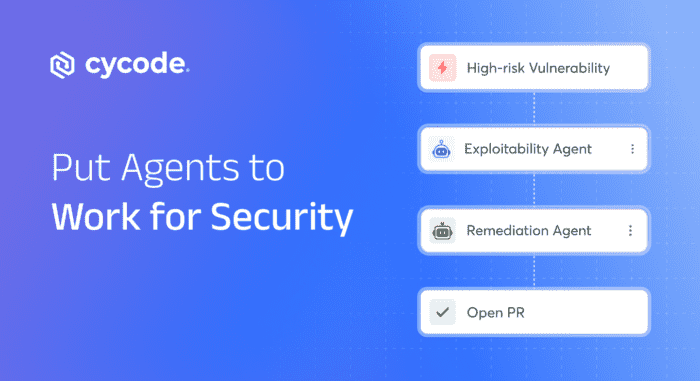
Build agent actions and flows. Once triggered, agents perform actions and trigger outcome-based downstream events automatically (including handing off to other agents). For example, a high-risk vulnerability could trigger the Exploitability Agent to determine whether the violation is exploitable. If it is exploitable, that triggers the Remediation Agent to generate a fix and open a pull request. If it is not exploitable, it can change the status or severity. Users can easily configure flows, confidence thresholds, and when scenarios require human approval.

Set human review and controls. None of this runs uncontrolled. You decide what events are in scope, the sequence of agent actions, and the conditions under which those actions execute autonomously or require human review. Start with focused workflows that triage critical CVEs with high EPSS in crown-jewel applications. Expand to trigger remediation for high-risk and exploitable vulnerabilities. Require human review of pull requests. Every run produces an audit trail of the triggering event, what each agent did, and which boundary applied, so nothing runs outside a scope you define.

Agentic Workflows in Practice: Automate Risk Management
While agentic workflows all share a similar structure, the possibilities and permutations for how you use them are endless. The patterns below represent ready-made templates to show how teams apply workflows to manage risks, from a newly disclosed CVE to a growing backlog to a slipping SLA.
Autonomous Triage
A new critical CVE drops. Instead of landing in a queue for someone to get to, a workflow picks it up the moment it’s detected and assesses it against your actual application context. Exploitable findings escalate for remediation. The rest are deprioritized automatically. The outcome that matters most is the one you never have to work: the flood of “critical” CVEs that aren’t exploitable in your environment never reaches a person. The response happens at the speed the risk appeared, not when the team can get to it.
Autonomous Remediation
A scan surfaces a high-risk, internet-exposed code weakness. Exploitability analysis confirms the data flow is reachable and unmitigated, and the finding hands off to a remediation agent that opens a pull request with a fix. A risk that would have persisted in a backlog is instead triaged and fixed automatically moments after the risk appeared. Human review sits wherever the team wants it, configured by confidence thresholds and filters.
Security Debt Burndown
Backlogs don’t shrink because someone finally finds time. They shrink because someone points effort (or more accurately, agents) at them systematically. Scope a workflow at your existing backlog, filtered to the repository, risk level, or CVE you want to target, and let agents work through it: analyzing, fixing, and routing approvals. Developers stop being the default owners of remediation campaigns and start reviewing a smaller, higher-confidence set of fixes agents have already produced.
Risk-Aware SLA Escalation
A high-risk Infrastructure as Code violation is approaching its remediation SLA ahead of a compliance audit. Its status flips from “on track” to “about to be missed.” Instead of firing another alert at an overloaded team, a workflow steps in to give them a hand: it triages for exploitability, then suppresses or fixes based on the outcome. The escalation produces agent-driven action, not another noisy notification.
Exception Review
A developer proposes an exception to ignore a high-severity CVE in a critical application. It goes into the log for security review as usual, but it also instantly triggers exploitability analysis. If the CVE isn’t exploitable, the workflow recommends accepting the exception. If it is, it alerts the code owner and reverts the finding to open. The routine request gets a second set of eyes automatically.
Container Remediation
A new high-risk container violation, or a missed SLA on one, triggers the Remediation Agent to evaluate the violation and check whether a fix is available. If one is, it initiates a container rebuild. Because the action reaches into build infrastructure, you can require human review and approval before execution.
Put Agents to Work for Your Security Program Today
Security’s math problem was never going to overcome human constraints. It gets solved by changing who does the work. Agentic Workflows shift the model from human-driven and agent-assisted to agent-driven and human-controlled. Agents carry the load of triage and remediation the moment risk appears, and your team sets the boundaries they operate within. That is how security finally scales with agentic development: not by using agents to assist human-driven operating models, but by changing the operating model and unleashing agents with confidence and control.
Agentic Workflows are currently in Early Access. Request a demo today and start putting agents to work for your security program.


