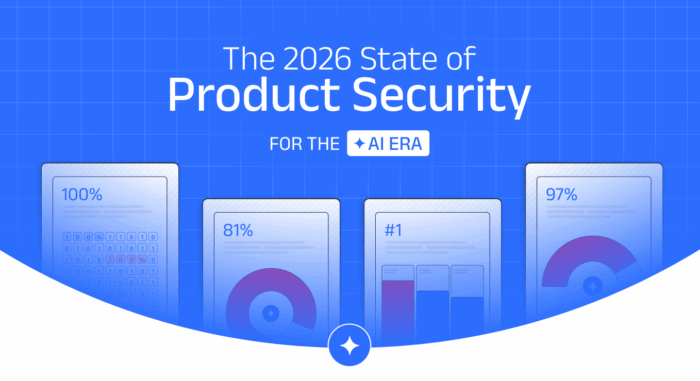

The State of Product Security in the AI Era Report: 97% of Organizations Are Using AI, But Only 19% Have Visibility
There’s no denying it: AI is delivering incredible benefits. Developers are coding faster, and businesses are reaping the rewards in productivity and efficiency.
But for security and product teams, this progress has created a new wave of questions. How do you govern tools that evolve weekly? How do you secure code written by a model, not a developer? How do you keep visibility when every team is experimenting with its own AI stack?
Those are the questions everyone in our industry is asking, which is why just about everyone has published a report on AI and security. Yet most of those discussions overlook the hardest part: governance, accountability, and how organizations are actually trying to solve these challenges in practice.
That’s why we commissioned the State of Product Security in the AI Era Report. We wanted to move past theory and measure what’s really happening beneath the surface. How AI-generated code is changing the shape of product security, where visibility and governance are breaking down, and what security leaders are doing to get ahead of it.
The takeaway is simple: AI has changed how we build software, and its adoption is outpacing security. As a security vendor, our mission is to help security teams close that gap and, in doing so, empower organizations to innovate at speed without compromising control.
Innovation Is Outpacing Adoption, and Adoption Is Outpacing Security
Every week brings another “must-have” AI tool, and development teams are racing to keep up. The pressure to move faster (to deliver, to innovate, to compete) is relentless.
That’s what we mean when we say innovation is outpacing adoption: new tools are emerging faster than teams can evaluate, integrate, or govern them. This gap creates FOMO; nobody wants to be the team missing out. But the gap between adoption and security is where risk creeps in.
New tools demand new guardrails…but most teams are still relying on old ones.
The data paints the picture clearly:
- 97% of organizations are already using or piloting AI coding assistants.
- 100% have AI-generated code somewhere in their codebase.
- Only 19% have full visibility into where and how AI is used.
- 65% say their overall security risk has increased since adoption.
- 100% of organizations are investing in AI-related initiatives
In other words: AI has become ubiquitous faster than it has become manageable. Security and product leaders are dealing with environments where even approved AI tools create visibility challenges, and unapproved ones multiply them.
But if it’s this hard to track sanctioned AI-generated code, what’s happening outside organizations’ purview?

Shadow AI Is the Byproduct of Speed Without Oversight
When we started this research, we weren’t just asking how fast AI was moving, we wanted to understand what happens when that speed outruns control. The data pointed us to one clear conclusion: the real risk isn’t just in how AI is used, but in how it’s governed.
More than half (52%) of organizations admit they lack a centralized framework to manage AI adoption. Decisions about which tools to use, what data they can access, and where they’re deployed are often made ad hoc, outside formal review.
Importantly, this isn’t intentional neglect. Developers and teams simply move faster than policies can.
That’s how and why Shadow AI (when individuals adopt unapproved AI tools, models, or plugins to meet deadlines and stay efficient) becomes both a productivity enabler and a ticking time bomb for security teams.
Many of these systems operate invisibly across the SDLC, introducing untracked dependencies and unvetted data flows. In practice, every AI integration and MCP becomes another supplier in the software supply chain.
Combine that with near-universal AI adoption and limited visibility, and you have the conditions for a perfect storm.
We’ve seen this pattern before. Incidents like SolarWinds and Log4j weren’t caused by a single vulnerability, they were enabled by fragmentation and blind spots. The rise of Shadow AI mirrors those same weaknesses, only amplified by automation and AI’s speed.
This isn’t alarmism, it’s pattern recognition. If you don’t know where your AI tools are, what data they touch, or how their outputs enter production, you can’t secure them.
Convergence Is the Only Way Forward
If there’s one message security leaders are sending loud and clear, it’s that AI risk can’t be managed in silos.
According to our research, 97% of organizations plan to consolidate their application security stack within the next 12 months. Every company (100%) is investing in AI-related initiatives, and three in four security leaders say their budgets are rising specifically to address AI-driven risks.
This marks a fundamental shift from the fragmented approach of the past. After years of point solutions and tool sprawl, security leaders have learned that adding more tools isn’t the answer. It’s the problem.
Cycode was built for this moment.
As the only AI-Native Application Security Platform, Cycode is purpose-built for the 10x developer era. It’s an agentic, always-on system that helps organizations identify, prioritize, and fix software risk across their environment. Our platform unifies visibility, context, and control from code to runtime, giving security teams the leverage they need to move at the speed of AI.
Here’s how we’re leading that evolution:
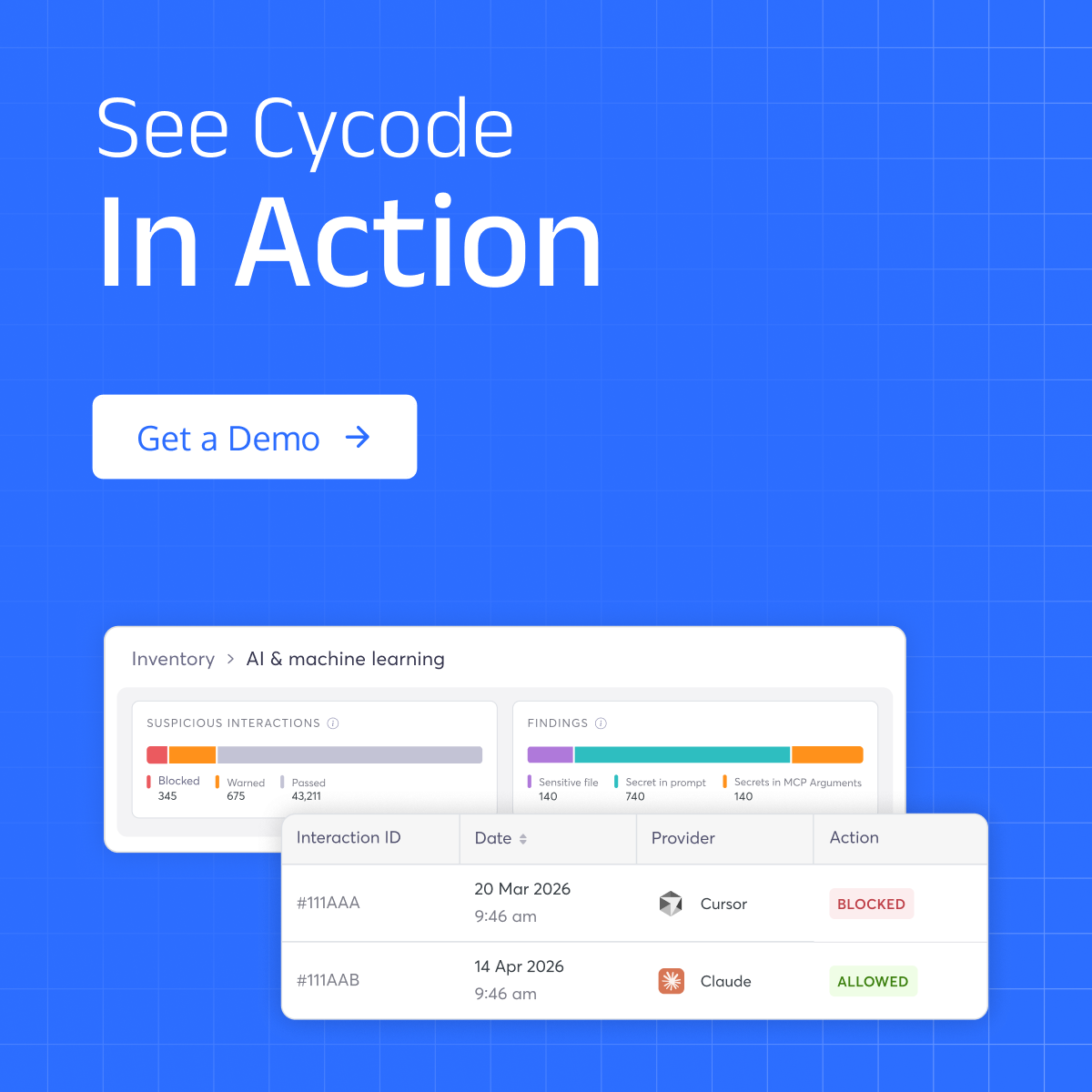
- Shadow AI Detection & AI/ML Inventory: Provides complete visibility into all AI and ML assets across the SDLC, helping teams discover, classify, and govern tools, models, and assistants before they become untracked risks.
- #1 Ranking in Gartner’s 2025 Critical Capabilities for Software Supply Chain Security: Recognized for securing pipelines, dependencies, and artifacts with unmatched precision, validating Cycode’s leadership in unifying AST and supply chain risk management.
- Named a Leader in the IDC MarketScape for ASPM 2025: Highlighted for delivering end-to-end visibility, prioritization, and remediation across the full software lifecycle, empowering teams to achieve true product security convergence.
The State of Product Security in the AI Era report offers a clear picture of how your peers are tackling these challenges, and what’s coming next. Download it now to benchmark your approach, and get in touch to see how Cycode can help you stay ahead of the curve.