Your Complete
Mythos Toolkit

Resources, guides, and checklists to help you build your readiness plan before the public CVE window opens. Cycode is trusted by Fortune 500 enterprises, including two Project Glasswing partners on the front line of Mythos, to secure the software the world depends on.

APR 7, 2026

Mythos Unveiled

Anthropic announces Claude Mythos and Project Glasswing. AI hits security-researcher-grade discovery.

APR – JUL 2026

The Quiet Before

The Glasswing coalition patches thousands of vulnerabilities behind closed doors. The clock starts.

TODAY
YOU ARE HERE

The Window to Prepare

The remediation muscle you build now determines how the next 12 months go.

JUL 2026

The Disclosures Begin

Glasswing patches become public CVEs. OpenAI’s Daybreak and Microsoft’s MDASH add to the flow. Backlogs spike.

6–18 MONTHS

The Avalanche

Mythos-class models become broadly accessible. Backlogs compound by orders of magnitude. Manual triage breaks.
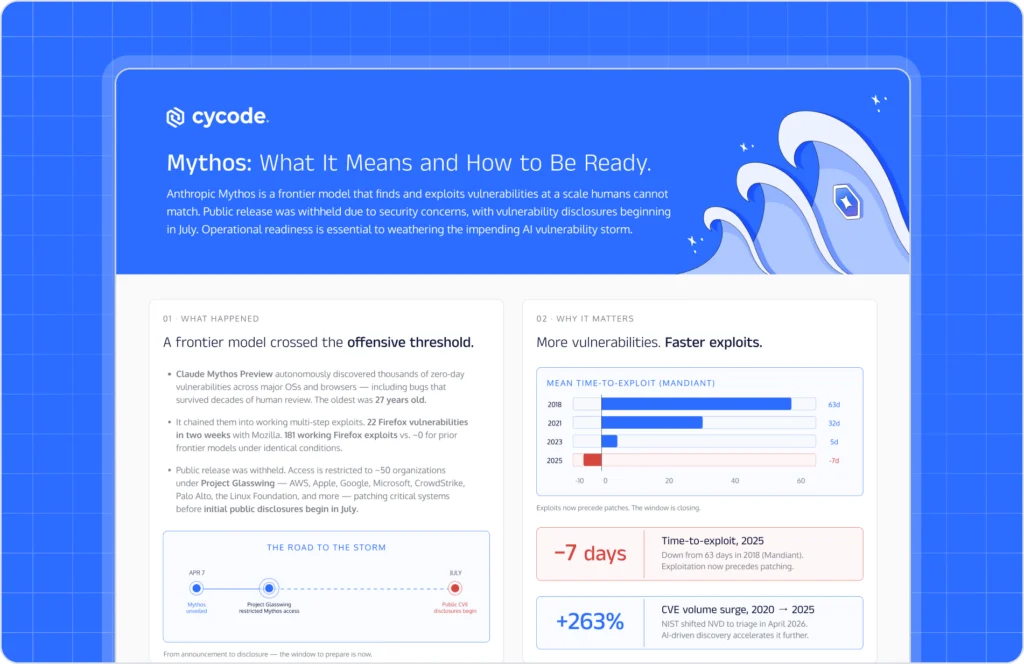
Cycode Mythos Guide

Mythos: What It Means
and How to Be Ready.

Download the free Mythos Readiness guide. With six steps Anthropic and the CSA recommend before July to get started with now, and a guide to how Cycode accelerates readiness, based on two Project Glasswing partners who are already using Cycode in their Mythos playbooks.

Mythos Guide

Close Mythos-Class Findings and Risks
With The Cycode Platform

THE CYCODE PLATFORM

How Cycode Fits in the Post-Mythos World

Many engines now find vulnerabilities. Only Cycode turns the full flow into action.

Discovery Sources

Findings arrive from
everywhere, at machine speed

Claude Mythos AI Lab
Cycode AI Discovery Native
SAST · SCA · Secrets · IaC Native
Runtime telemetry Native

Discovery is no longer the bottleneck. Cycode is the most cost-effective way to operationalize Mythos-class findings, alongside your existing scanners and runtime signals.

The Cycode Platform

The Agentic Development Security Platform

Context Intelligence Graph Correlates every finding with ownership, reachability, and blast radius.
Maestro Orchestration AI agents triage, confirm exploitability, and remediate at machine speed.
Remediation & Governance AI routes fixes, tracks SLAs, verifies patches, and governs the agents doing the finding.
Deterministic + Non-Deterministic Layers Auditable infrastructure for what you can prove. Adaptive intelligence for what you can't predict.
Outcomes

Risk closed at the speed
AI created it

Critical risk closed 17× faster
MTTR reduced by 99% on critical vulnerabilities
AI-generated, PR-ready fixes with minimal human intervention
Audit-ready evidence of AI governance and remediation

The system isn't faster scanning. It's a closed loop from finding to fix, built for AI scale.

Frequently Asked Questions About Mythos

What is Claude Mythos and why does it matter for security teams?

Claude Mythos is Anthropic's frontier AI model with security-researcher-grade vulnerability discovery capabilities. In pre-release testing through Project Glasswing, it autonomously discovered thousands of zero-day vulnerabilities across major operating systems, browsers, and open-source libraries, including a 17-year-old remote code execution bug in FreeBSD and a 27-year-old vulnerability in OpenBSD. Mythos matters because it represents a structural shift. Vulnerability discovery, once gated by elite human expertise, is now available at machine speed and machine scale. When Glasswing patches become public CVEs starting in July 2026, every security team running standard software will face one of the largest disclosure waves in industry history.

When will the Mythos-discovered vulnerabilities become public?

The first wave of public disclosures is expected in July 2026, when the Project Glasswing coalition publishes its summary report and the patches that have been quietly developed over the preceding months begin appearing in CVE databases. OpenAI's Daybreak program and Microsoft's MDASH are running in parallel and are expected to add to the disclosure flow. Subsequent waves will follow as Mythos-class capabilities become more broadly accessible. Anthropic estimates 6 to 18 months until open-source equivalents reach comparable capability.

How is this different from past major CVE events like Log4Shell or Heartbleed?

Past major CVE events were periodic. Heartbleed, Shellshock, Spectre, and Log4Shell were spaced out enough that the industry had time to mobilize between them. The Mythos era is structurally different in three ways. First, discovery is no longer rate-limited by human expertise, so the cadence of major disclosures will accelerate dramatically. Second, attackers will have access to the same discovery capabilities defenders do, often before patches are widely deployed. Third, AI can now generate exploit code at machine speed, tailored to the specific vulnerabilities it discovers. Past CVE events were one-time storms. The Mythos era is closer to a continuous, compounding pressure on remediation infrastructure.

What should security teams do now to prepare for the coming CVE flood?

Three things matter more than they did a year ago, and none of them are new ideas. They have just become non-optional. First, stress-test your mean time to remediate by running quarterly drills that simulate 10 or more critical CVEs hitting your stack simultaneously, and measure where the friction is. Second, move prioritization off raw CVSS scores and onto runtime context: reachability, exposure, blast radius, and business impact. A critical CVE in an air-gapped test system is not the same as the same CVE in a production system handling customer data. Third, build a remediation pipeline that can run at machine speed, with agentic workflows that take a triaged finding through ownership identification, fix generation, PR creation, and deploy planning without a human pulling each step forward by hand. Calendar-speed remediation cannot keep pace with machine-speed discovery. That is a structural fact, not a productivity problem.

How does Cycode help with Mythos and AI-scale vulnerability remediation?

Cycode is built for the moment when vulnerability discovery moves at machine speed and remediation has to follow. Our platform unifies findings from across your software factory, including code, dependencies, pipelines, and runtime, into a single Context Intelligence Graph that correlates each finding with ownership, reachability, blast radius, and business impact. That correlated context is what enables prioritization that actually matches risk, not just CVSS scores. From there, Cycode Maestro orchestrates purpose-built AI agents that triage findings, confirm exploitability, identify code owners, and generate PR-ready fixes, closing the loop from discovery to deployment without manual coordination at every step. The result: organizations remediate critical and high-severity risk 17 times faster than industry benchmarks, with the agentic infrastructure to keep pace as discovery accelerates.