
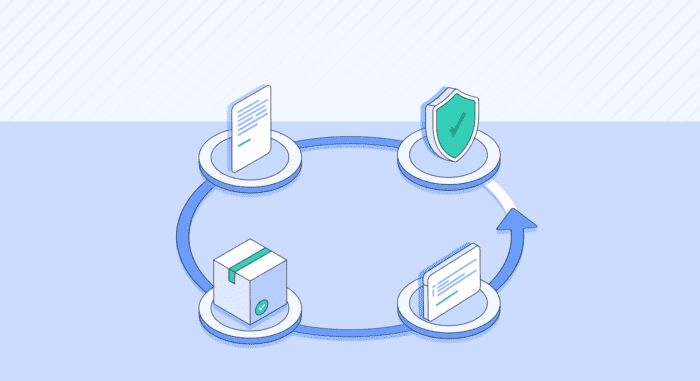

AI agents now write code, pull dependencies, run tests, and open pull requests inside enterprise pipelines, sometimes without a developer ever opening an IDE. This shift has a name: the agentic development lifecycle (ADLC). It changes who does the work at each stage of software delivery, and it changes what can go wrong.
The change is happening faster than most security programs can absorb. Gartner projects that 33% of enterprise software applications will include agentic AI by 2028, up from less than 1% in 2024. This guide covers what the ADLC is, how its stages work, the risks it creates, and how to secure it before agents ship code you have not reviewed.
Key Highlights
- The agentic development lifecycle (ADLC) is a software development model in which autonomous AI agents perform tasks across the development lifecycle, from planning through deployment.
- The ADLC keeps the familiar SDLC stages but hands execution to agents, so code moves at machine speed with far less human review per change.
- Agent autonomy creates new risks, including hallucinated dependencies, secrets leaked through prompts, and agents with more access than they need.
- Cycode secures the ADLC with AI visibility, governance, real-time guardrails, and Maestro, its agentic security orchestration engine.


What Is the Agentic Development Lifecycle?
The agentic development lifecycle (ADLC) is a software development model in which autonomous AI agents perform tasks across the development lifecycle. A developer states an intent, something like “build a password reset flow,” and agents handle the rest: they plan the work, write the code, choose dependencies, run tests, and open a pull request.
The ADLC builds on the traditional SDLC rather than replacing it. Planning, coding, testing, review, deployment, and maintenance all still happen. What changes is who executes each stage. In a traditional SDLC, humans do the work and tools assist. In the ADLC, agents do the work and humans set direction, define boundaries, and review outcomes.
That is also what separates the ADLC from basic AI coding assistance. An autocomplete tool like a code suggestion plugin responds to a prompt and waits. The developer stays in the loop at every decision. An agent in the ADLC pursues a goal across many steps on its own. It can iterate through a debugging loop a dozen times, touch forty files, and hand back a finished artifact before anyone looks at it.
One naming clarification, because it trips people up. Some vendors, including IBM and Salesforce, use “Agent Development Lifecycle” to describe the process of building and operating AI agents themselves: designing them, evaluating them, and monitoring their behavior in production. That is a different topic. This article covers agents building software, not the development process of the agents.
Here is a quick comparison of the three delivery models running in parallel across the industry right now:
| Model | Who Executes | Human Role |
|---|---|---|
| Traditional SDLC | Humans at every stage. | Write, review, and ship the code. |
| AI-assisted development | Humans, with AI suggestions. | Direct every step and accept or reject output. |
| Agentic development lifecycle (ADLC) | Autonomous agents. | Set intent, define guardrails, review results. |
Why Enterprises Should Secure the Agentic Software Development Lifecycle
Enterprises should secure the agentic software development lifecycle because it changes the speed, scale, and autonomy of software creation faster than existing security controls can keep up. Every gain the ADLC delivers also widens the attack surface, which is why Agentic AI security has become a discipline of its own.
In Cycode’s State of Product Security for the AI Era 2026 research, 100% of surveyed organizations confirmed they have AI-generated code in their codebases, yet 81% have no visibility into how AI is used across their development lifecycle.
- Faster Development Cycles: Agents produce and merge code in minutes. Security reviews built around sprint cadences cannot keep up.
- Greater Task Automation: Agents pull dependencies, call APIs, and configure infrastructure on their own. Each automated action is a decision no human checked.
- Increased Developer Productivity: Teams ship more code per engineer. More code means more surface to scan, govern, and patch.
- Broader Access to Software Creation: People outside engineering can now direct agents to build working software. Security teams often never learn these projects exist.
- Changing Developer Responsibilities: Developers spend less time writing code and more time reviewing agent output. Review fatigue is real, and vulnerable code slips through when reviewers trust the agent too much.
- Machine-Speed Security Risks: A flaw an agent introduces can replicate across dozens of repositories before a weekly scan would have caught it once.
What Are the Main Stages of the ADLC?
The ADLC has six main stages: defining requirements and guardrails, planning architecture, generating code, testing, review and deployment, and monitoring. Unlike the traditional SDLC, these stages are not strictly sequential. Agents move between stages freely and often run several tasks at once, so a testing agent may already be validating one module while a coding agent is still writing the next.
1. Define Application Requirements and Guardrails
Everything downstream depends on this stage. The team translates business intent into instructions an agent can act on, and just as important, into boundaries the agent cannot cross. Vague intent produces confident, wrong software. So do missing boundaries, which is why teams pair requirement definitions with AI guardrails that block risky prompts and data exposure before agents start working.
A brief an agent can act on safely settles a few things up front:
- Write requirements as specific, testable statements rather than loose feature descriptions.
- Define which data, systems, and credentials agents may touch.
- Decide which actions need human approval before an agent executes them.
2. Plan App Architecture and Tasks
Agents break the stated intent into an architecture and a task list. This is where a small mistake compounds, because every later stage inherits the plan. It is also where AI governance matters most: the organization needs to know which agents, models, and tools are allowed to participate in planning at all, and under which policies.
Keeping the plan trustworthy takes a mix of human sign-off and tool limits:
- Have agents propose the architecture, then require human sign-off before implementation.
- Restrict planning agents to approved models and MCP servers.
- Record the plan so later stages can be audited against it.
3. Generate Source Code and Select Dependencies
This is the stage most people picture when they hear “agentic development.” Agents write the implementation, and they also pick the packages it depends on, which is where things get dangerous. Research presented at the USENIX Security Symposium in 2025 found that roughly 20% of package references in AI-generated code pointed to packages that do not exist. Strong AI code security controls have to run at the point of generation, not after the code lands in a repository.
So the checks have to sit where the code is written:
- Scan agent-generated code before commit, in the environment where the agent works.
- Verify that every dependency an agent selects actually exists and is approved.
- Block commits that carry hardcoded secrets or known vulnerable patterns.
4. Test and Validate Code Changes
Agents write their own tests, run them, and iterate on failures until the suite passes. That closes functional gaps quickly, but a passing test suite says nothing about security. An agent will happily write tests that confirm its own insecure logic works as written. Independent validation with code analysis tools catches what the agent’s self-checks miss.
Independent validation is what makes this stage worth anything:
- Run SAST, SCA, and secrets detection on every agent-generated change.
- Keep security scanning independent from the agent that wrote the code.
- Fail the pipeline on critical findings instead of logging them for later.
5. Review and Deploy Software
Merge and deploy remain the stages where humans hold the most authority, but the volume problem is severe. When agents open pull requests faster than reviewers can read them, review becomes a rubber stamp. The fix is to let automation handle the checks machines do well and reserve human attention for judgment calls.
The split between automation and human attention works like this:
- Gate merges on automated security checks that run at generation speed.
- Focus human review on architecture, access changes, and business logic.
- Trace every deployed change back to the agent and prompt that produced it.
6. Monitor and Improve the Application
The ADLC does not end at deployment. Agents watch production telemetry, investigate alerts, propose fixes, and in mature setups, open remediation pull requests on their own. Monitoring here covers two things: the application itself and the behavior of the agents operating on it.
Watching the agent side comes down to a few habits:
- Monitor agent tool calls, credential access, and outbound connections.
- Alert on behavior that falls outside an agent’s defined scope.
- Feed production findings back into the guardrails set in stage one.
What Are the Main Security Risks in the Agentic Dev Lifecycle?
The main security risks in the agentic dev lifecycle come from three properties working together: agents act autonomously, agents hold access to real tools and credentials, and agents operate at machine speed. Any one of these is manageable. Combined, they mean a single bad decision can propagate across an entire codebase before a human notices.
| Security Risk | What It Means | Potential Impact |
|---|---|---|
| Vulnerable Agent-Generated Code | Agents reproduce insecure patterns from training data, such as weak input validation and outdated cryptography. | Exploitable flaws ship to production at a volume manual review cannot catch. |
| Exposed Secrets and Sensitive Data | Credentials leak through prompts, agent file reads, and hardcoded values in generated code. | Attackers gain valid credentials, and the exposure never appears in git history. |
| Hallucinated or Compromised Dependencies | Agents reference packages that do not exist, which attackers register with malicious payloads. | A supply chain attack enters the codebase through a dependency no human chose. |
| Excessive Agent Permissions | Agents inherit broad credentials so they can complete varied tasks without friction. | One compromised agent session becomes a master key across repos, pipelines, and cloud. |
| Code Injection and Untrusted Tools | Malicious instructions hidden in files, docs, or MCP tool descriptions redirect agent behavior. | The agent executes an attacker’s goal using its own legitimate access. |
| Limited Visibility and Machine-Speed Failures | Agents commit through CLI and API paths that traditional monitoring never watches. | Failures spread across dozens of repositories before detection, and forensics is slow. |
Prompt injection deserves special mention because it inverts the usual attack model. The attacker never needs to breach your systems. They only need to place text somewhere an agent will read it, in a README, a ticket, or a tool description, and the agent carries out the attack with its own permissions.
How to Secure the Agentic SDLC
Securing the agentic SDLC requires controls across five layers: the agents themselves, the tools they call, the data they touch, the code they produce, and the workflows that deploy it. No single scanner covers all five. ADLC security works when these controls run continuously and at the same speed as the agents, because a daily scan against machine-speed development is roughly the same as no scan.
Inventory and Govern AI Tools and Agents
You cannot write a policy for tools you do not know exist. Most organizations underestimate how much AI already runs in their pipelines: coding assistants developers installed themselves, MCP servers connected without review, and models referenced deep in config files. The first control is a live inventory, and the second is an authorization workflow that decides what stays.
A useful inventory does more than list what it finds:
- Auto-discover AI assistants, models, MCP servers, and AI secrets across every repository.
- Assign each discovered tool an authorization state and flag unauthorized use as a violation.
- Maintain an AI Bill of Materials (AIBOM) for audit and compliance reporting.
Learn how to Master AI governance with Cycode.
Apply Least-Privilege Access
Agents tend to accumulate access. It is convenient to give a coding agent write access everywhere so it never gets blocked mid-task, and that convenience is exactly what makes a compromised agent catastrophic. The principle of least privilege applies to agents even more strictly than to humans, because agents cannot notice that something feels off before they act.
For agents, least privilege turns into a few concrete rules:
- Give every agent its own identity with scoped, task-level permissions.
- Grant sensitive access just in time and revoke it when the task ends.
- Never let agents share credentials with each other or with human accounts.
Protect Prompts and Sensitive Data
The IDE and CLI are now data gateways. Every prompt, file read, and tool call is an outbound flow to an external service, and none of it shows up in git history or CI scans. A developer pastes a connection string while debugging, or an agent reads a .env file to build context, and the secret is gone before any traditional control fires.
Enforcement has to sit at each point where data can leave:
- Scan outbound prompts for secrets and sensitive data before they leave the IDE.
- Block agent file reads on sensitive paths such as .env files and key stores.
- Inspect MCP tool call payloads and stop calls carrying embedded credentials.
Scan and Review Agent-Generated Changes
Agent-generated code needs the same scrutiny as human code, delivered at a very different speed. The practical answer is to move scanning to the point of generation, so the agent gets security feedback inside its own loop and fixes issues before the code ever reaches a repository. Post-commit scanning still matters, but by then a vulnerable pattern may already exist in ten places.
Where you scan matters as much as what you scan for:
- Scan in the IDE and agent environment first, then again in the pipeline.
- Validate dependencies at selection time to catch hallucinated packages.
- Prioritize findings by exploitability so teams fix real risk instead of noise.
Analyze Agent Activity and Prepare for Incidents
Agent behavior is the new telemetry. An agent that reads secrets and then makes an outbound API call is either doing its job or being manipulated, and only pattern analysis over time can tell the difference. Incident response also needs rework, because the “insider” in an ADLC incident may be an agent following injected instructions, and containment means revoking machine identities, not disabling a user account.
Readiness here rests on the logging and the drill:
- Log every agent tool call with full input, output, and decision context.
- Build kill switches that isolate an agent and revoke its credentials in seconds.
- Run incident drills that assume the compromised actor is an agent, not a person.
Secure Your Agentic Development with Cycode
Most security vendors have added AI features to platforms built for human-paced development. While Cycode secures your traditional SDLC it is also built the Agentic Development Security Platform for the ADLC itself, covering both sides of the problem: securing the AI layer developers use, and deploying AI agents to run security work at the speed agents write code. Cycode AI connects visibility, governance, protection, and orchestration in one platform, on one graph.
- AI Visibility auto-discovers shadow AI, coding assistants, models, and MCP servers across the software factory.
- AI Governance enforces policy with allowlists, authorization workflows, and a live AIBOM.
- AI Guardrails intercept secrets in prompts, file reads, and MCP tool calls before they leave the IDE.
- AI Risk Detection surfaces AI-specific weaknesses aligned to the OWASP LLM Top 10.
- The Context Intelligence Graph maps code-to-cloud risk so every finding carries ownership and blast radius.
- Cycode Maestro orchestrates AI Teammates that confirm exploitability, generate fixes, and open PRs, closing critical findings 17x faster.
The agentic development lifecycle rewards teams that move fast and punishes teams that secure it as an afterthought. Book a demo today and see how Cycode helps organizations secure the agentic development lifecycle without slowing software delivery.
Frequently Asked Questions
How Does the Agentic Development Lifecycle Fit into the Traditional SDLC?
The ADLC keeps the same stages as the traditional SDLC and changes who executes them. Planning, coding, testing, review, deployment, and maintenance all still exist, but agents now handle the execution while humans set intent and review outcomes. Most enterprises run both models side by side today, with some teams fully agentic and others still human-driven.
That overlap is why SDLC security fundamentals still matter in agentic environments. Secrets detection, dependency scanning, and pipeline integrity checks protect code regardless of who or what wrote it. The ADLC adds new requirements on top, such as agent governance and prompt protection, rather than replacing the old ones.
How Is the Agentic Dev Lifecycle Different from the AI Agent Lifecycle?
The two terms sound similar and describe different things. The agentic dev lifecycle covers AI agents building software: writing code, selecting dependencies, and deploying applications. The AI agent lifecycle, sometimes called the Agent Development Lifecycle by vendors like IBM and Salesforce, covers building the agents themselves, including their design, evaluation, and production monitoring.
The distinction matters because each requires a different security model. Securing the ADLC means governing what agents do to your codebase, such as controlling permissions and scanning generated code. Securing the AI agent lifecycle means hardening the agents as products, which involves testing their reasoning, protecting their memory, and evaluating their behavior over time.
What Are the Main Use Cases for Agentic AI in the SDLC?
Agentic AI in the SDLC runs several production workflows today. Coding agents take a ticket and deliver a full implementation with tests and an open pull request. Debugging agents trace failures from a stack trace, hypothesize causes, and iterate on fixes until tests pass, while refactoring agents apply structural changes across dozens of files at once.
Security itself is one of the strongest use cases, because human teams cannot triage findings at the speed agents create code. AI security orchestration coordinates specialized agents that confirm exploitability, prioritize by real risk, and generate remediation PRs without manual handoffs. In practice, this is how security teams keep pace with the volume the rest of the ADLC produces.
Can Traditional DevSecOps Tools Secure the ADLC?
Traditional tools cover part of the problem, but not the parts the ADLC introduces. Scanners built for human-paced development assume code arrives through IDEs and pull requests at a reviewable rate. Agents bypass those assumptions by committing through CLI and API paths, moving at machine speed, and introducing risks like prompt injection and hallucinated dependencies that legacy rule sets were never designed to detect.
The gap shows up most clearly in monitoring and enforcement. Classic DevSecOps security tools watch code and pipelines, while ADLC security also has to watch agent behavior, MCP connections, and outbound prompts. Enterprises typically keep their existing scanners and add an agentic security layer on top, rather than ripping anything out.


