Comprehensive
Application Security for Financial Services
Environments
Financial institutions are no longer just banks; they are software companies handling the world’s most sensitive data. As AI-driven development accelerates the release cycle, application security for financial services must evolve from a manual bottleneck into an automated, agentic defense system that secures the entire code-to-cloud journey.


















{the gaps}
Human-LedFinancial Application Security Is Broken
The AI revolution didn't just accelerate fintech development; it fundamentally broke traditional software security models where human-led banking security teams alone can’t keep up.
Get a Demo
Everyone's a 10x Developer. Your Compliance Team Isn't.
The AI revolution didn't just accelerate fintech development; it fundamentally broke traditional software security models where human-led banking security teams alone can’t keep up.

Financial Attacker Velocity Has Skyrocketed by 10x
Risks to sensitive transaction logic and PII are being exploited faster than ever. AI is amplifying financial threat actors, enabling simultaneous targeting across traditional APIs and new, AI-driven attack surfaces. Automated exploits now find vulnerabilities in banking systems before teams can even start triage.

AI Writes the Banking Code and Expands the Attack Surface
AI-native components are now part of your core financial infrastructure. Also, AI is authoring pull requests, reviewing commits, and automating tests for fintech apps, amplifying risk across both infrastructure and code generation. Without visibility into the Context Intelligence Graph, your bank has a blind spot where AI-generated logic touches sensitive customer data.
{Surface Risks}
Financial Application Security
for Every Layer of Your Service
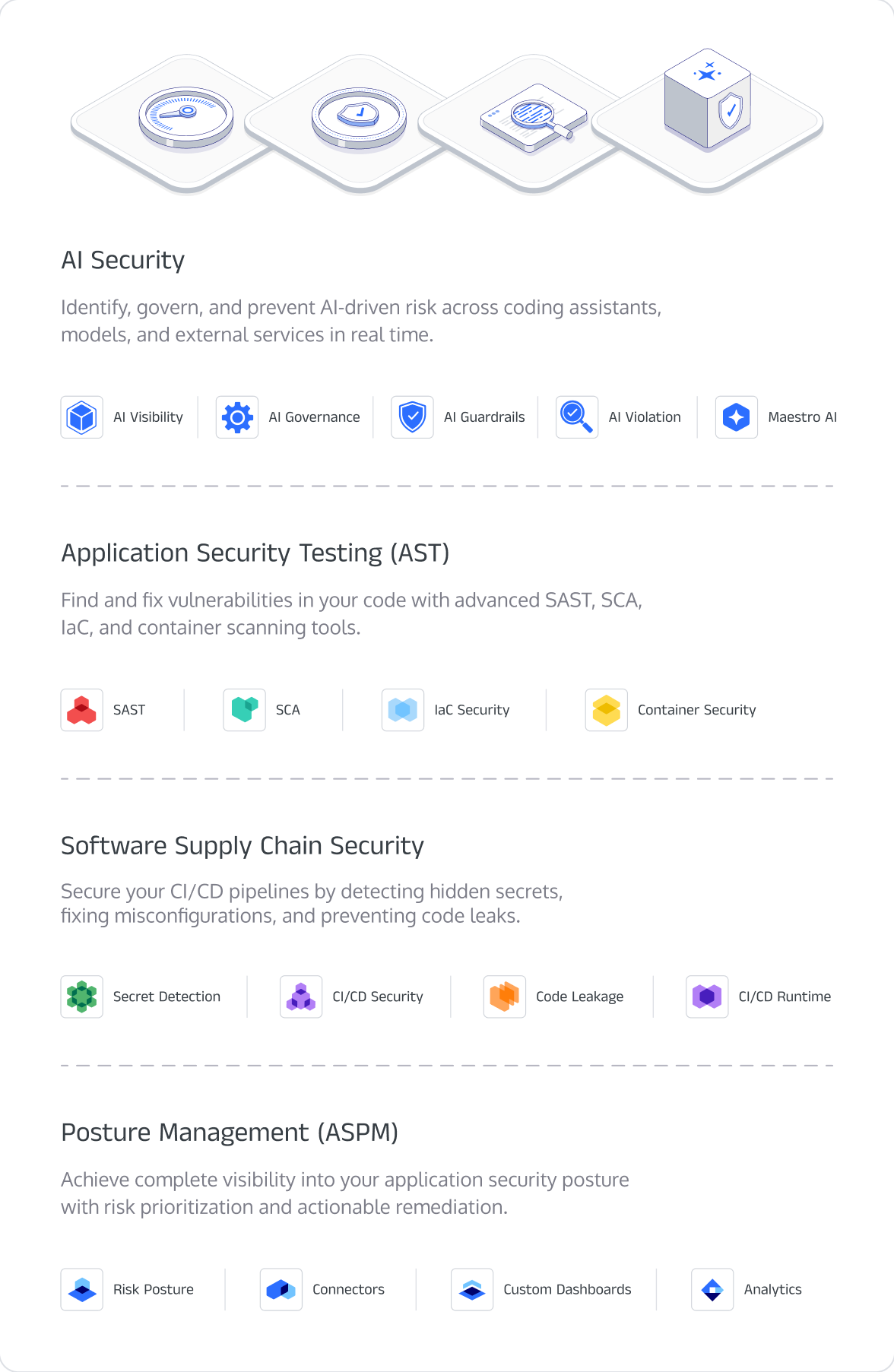
Modern banking architecture is a complex web of legacy systems, microservices, and third-party integrations. To maintain a resilient Application Security program, security must be embedded into every layer of the SDLC, ensuring that speed never comes at the cost of safety.

Visibility across the "Shadow AI" landscape Identify unauthorized AI tools and MCP servers that could leak sensitive financial logic.

Proactive Guardrails Stop secrets and PII from leaving the developer’s IDE and entering LLM prompts.

Contextual Prioritization Use connective intelligence to understand which vulnerabilities actually pose a risk to your production environment.
{Open Source Security}
Secure Open Source Dependencies in Financial Services
Open source software (OSS) is the backbone of modern fintech, but it also introduces transitive risks that can bypass traditional perimeter defenses.

Automated AIBOM Generation: Maintain a real-time AI Bill of Materials to track every model and library in your stack.

Vulnerability Reachability: Determine if a vulnerable package is actually reachable in your production environment to reduce developer friction.

License Compliance: Automatically enforce financial data security standards by blocking libraries with restrictive or risky licenses.
{Custom Code Security}
Protect Proprietary Financial Applications
Your custom code contains the "secret sauce" of your financial products, making it a prime target for high-level threat actors.

Hardcoded Secret Detection: Scans for API keys and credentials with the lowest false-positive rate in the industry.

Agentic Remediation: Use the Cycode Fix & Remediation Agent to generate pull requests that resolve vulnerabilities without breaking production logic.

Code Integrity: Ensure that the code written by your developers is the exact code running in your cloud.
{API Security}
Secure APIs
Used in Open Banking and Fintech Integrations
APIs are the front door for open banking, but they also expand the attack surface and create new opportunities for data exfiltration.

API Inventory Discovery: Automatically map every internal and external endpoint to eliminate "zombie" APIs.

Sensitive Data Tracking: Monitor how PII and financial data flow through your endpoints to ensure financial data security compliance.

Leaked Credential Protection: Prevent unauthorized access by identifying exposed API tokens across public and private repositories.
{Cloud and Containers}
Extend Application Security Across
Cloud-Native Financial Workloads
Moving to the cloud requires more than just scanning containers; it requires a unified view of risk from the first line of code to the running workload.

Infrastructure as Code (IaC) Security: Identify misconfigurations in Terraform or Kubernetes before they reach production.

Code-to-Cloud Traceability: Use the Risk Intelligence Graph (RIG) to link cloud alerts back to the specific developer and line of code.

Continuous Compliance: Maintain a real-time audit trail to satisfy cybersecurity requirements for financial services companies.
Enterprise-Grade Financial Services Application Security
A fragmented security stack is a liability in a high-stakes industry.
Cycode provides a unified, AI-native platform that replaces tool sprawl with a single source of truth for financial application security.

Centralized AppSec Risk Management
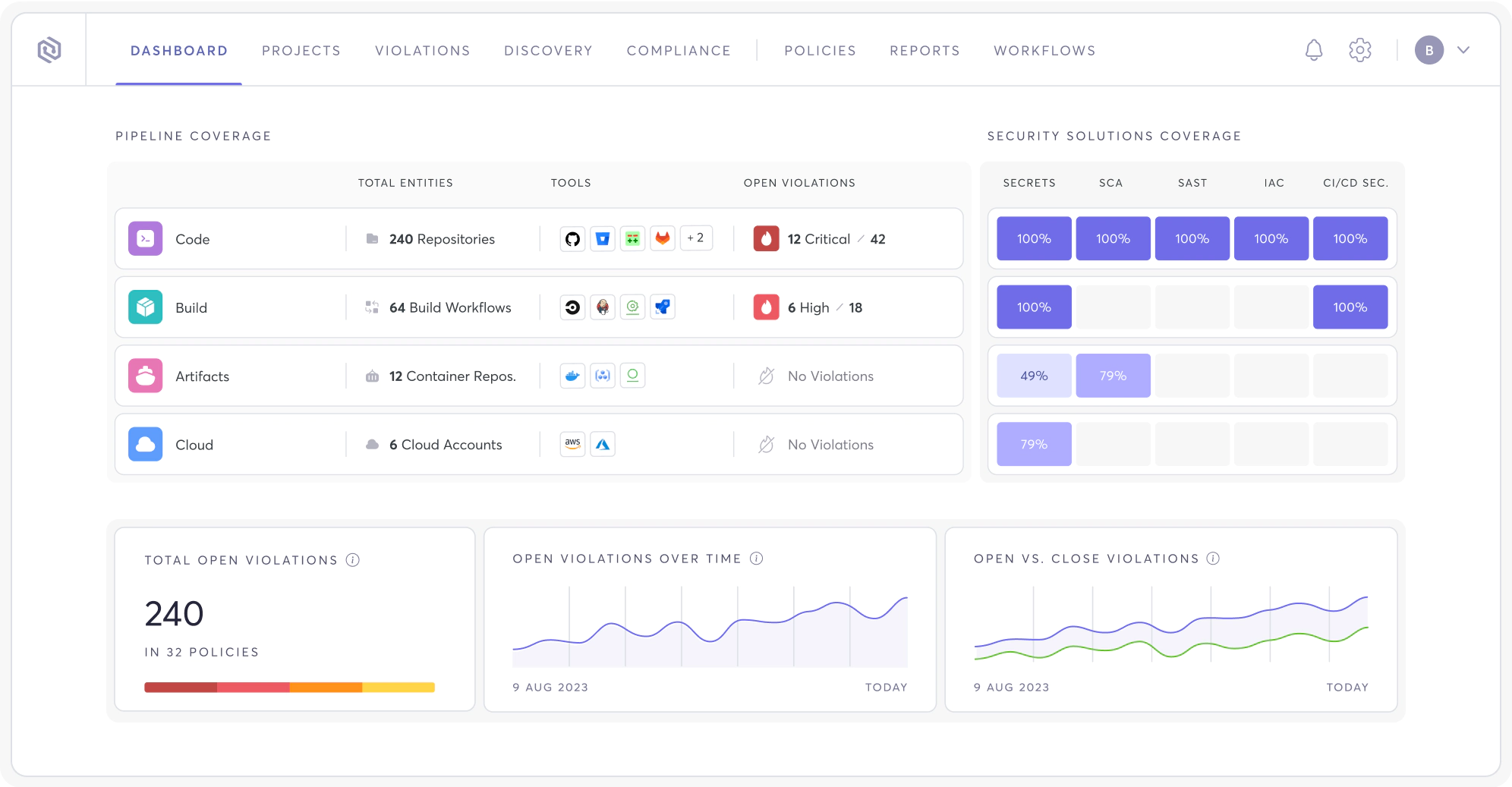
Consolidate findings from SAST, DAST, SCA, and cloud security into one prioritized view, allowing teams to mitigate risks based on actual business impact.

Support Compliance and Audit Readiness
Cycode automates the evidence-gathering process for financial services cybersecurity regulations, ensuring you are always ready for SOC 2, PCI DSS, and GLBA audits.

Reduce Tool Sprawl and Security Overhead
By consolidating disparate app security tools into a single platform, financial institutions can reduce licensing costs and eliminate the "alert fatigue" that plagues security operations.
Frequently Asked Questions About Application Security Testing (AST)
What Is Application Security for Financial Services?
Beyond basic scanning, a modern application security program must address the "10x Gap" created by AI-accelerated development. By unifying SAST, SCA, and secrets detection into a contextual risk model, financial institutions can move from reactive patching to agentic defense, ensuring that security keeps pace with the speed of innovation.
Why Is Financial App Security Critical for Organizations?
For a modern financial institution, security is no longer just a defensive necessity; it is a competitive differentiator. Organizations that leverage an AI-native AppSec program can secure their financial systems at machine speed, ensuring that high-velocity innovation doesn't create high-velocity risk. By protecting customer data with agentic workflows, you satisfy regulatory compliance mandates while maintaining the agility needed to lead the market.
What Are the Main Types of Financial Service App Security Risks?
To effectively mitigate risks, financial institutions must look beyond simple SQL injections and focus on "Model Inversion" and "Prompt Injection" within their AI-powered features. Protecting the software supply chain now requires a unified view of proprietary code and third-party dependencies, ensuring that a single compromised library doesn't lead to a systemic failure across your digital banking platform.
How Do APIs Increase Security Risk in Financial Services Applications?
Cycode helps security teams regain control by providing real-time visibility into the entire API ecosystem. By mapping how data flows from code to production, our platform identifies "Shadow APIs", endpoints deployed without security oversight, and enforces strict API security policies. This ensures that every integration, whether with a third-party payment processor or an internal microservice, is authenticated, authorized, and monitored for anomalies.sensitive information.
What Are the Core Cybersecurity Regulations for Financial Institutions?
Failure to meet these cybersecurity requirements for financial services companies results in more than just fines; it can lead to the revocation of operating licenses. By centralizing data security within an AI-native platform, institutions can automate the collection of audit evidence, turning a manual compliance "checkbox" exercise into a continuous, real-time stream of verified security data.
How Does Financial Services Cybersecurity Support Compliance and Audit Requirements?
This automation is critical for the financial services industry, where audit cycles are frequent and intense. By mapping every vulnerability back to its source and tracking the remediation timeline, Cycode ensures that your organization is always "audit-ready." This transparency reduces the overhead of compliance and allows security leaders to provide the board with clear, data-driven proof of risk reduction.
What Is Financial Application Security Risk Management?
In the 2026 threat landscape, risk is not static. A vulnerability that was low-risk yesterday can become critical today if a new AI-driven exploit is released. By using the Risk Intelligence Graph (RIG), Cycode provides a dynamic view of risk that considers the proximity of a vulnerability to sensitive financial data and its exposure to the public internet.
How Can Financial Institutions Secure Open Source Software?
The key to securing the supply chain in a bank or fintech is automation. Manual reviews of every library are impossible at 10x speed. Cycode’s AI-native platform automatically evaluates the reputation and security posture of every dependency in real-time, ensuring that only trusted, compliant code makes it into your production environment.
How Does Application Security Testing Differ for Banks and Fintech Companies?
| Feature | Traditional Banking (Legacy) |
Modern Fintech (Cloud-Native)
|
|---|---|---|
|
Primary Risk
|
Hardcoded secrets in legacy code
|
Shadow AI & API exposure
|
|
Testing Speed
|
Scheduled / Periodic
|
Continuous / Real-time
|
|
Tooling Needs
|
Heavy focus on SAST/DAST
|
Focus on ASPM, RIG, & Agentic Fixes
|
|
Regulatory Focus
|
PCI DSS, GLBA, SOX
|
DORA, EU AI Act, GDPR
|
How Does Cycode Support Application Security for Financial Services?
This "Connective Intelligence" allows security teams to use natural language queries via Maestro to investigate complex risks, such as Shadow AI usage or exposed PII in LLM prompts. By automating triage and remediation through specialized AI agents, Cycode helps financial organizations reduce tool sprawl while maintaining strict audit readiness and compliance.