
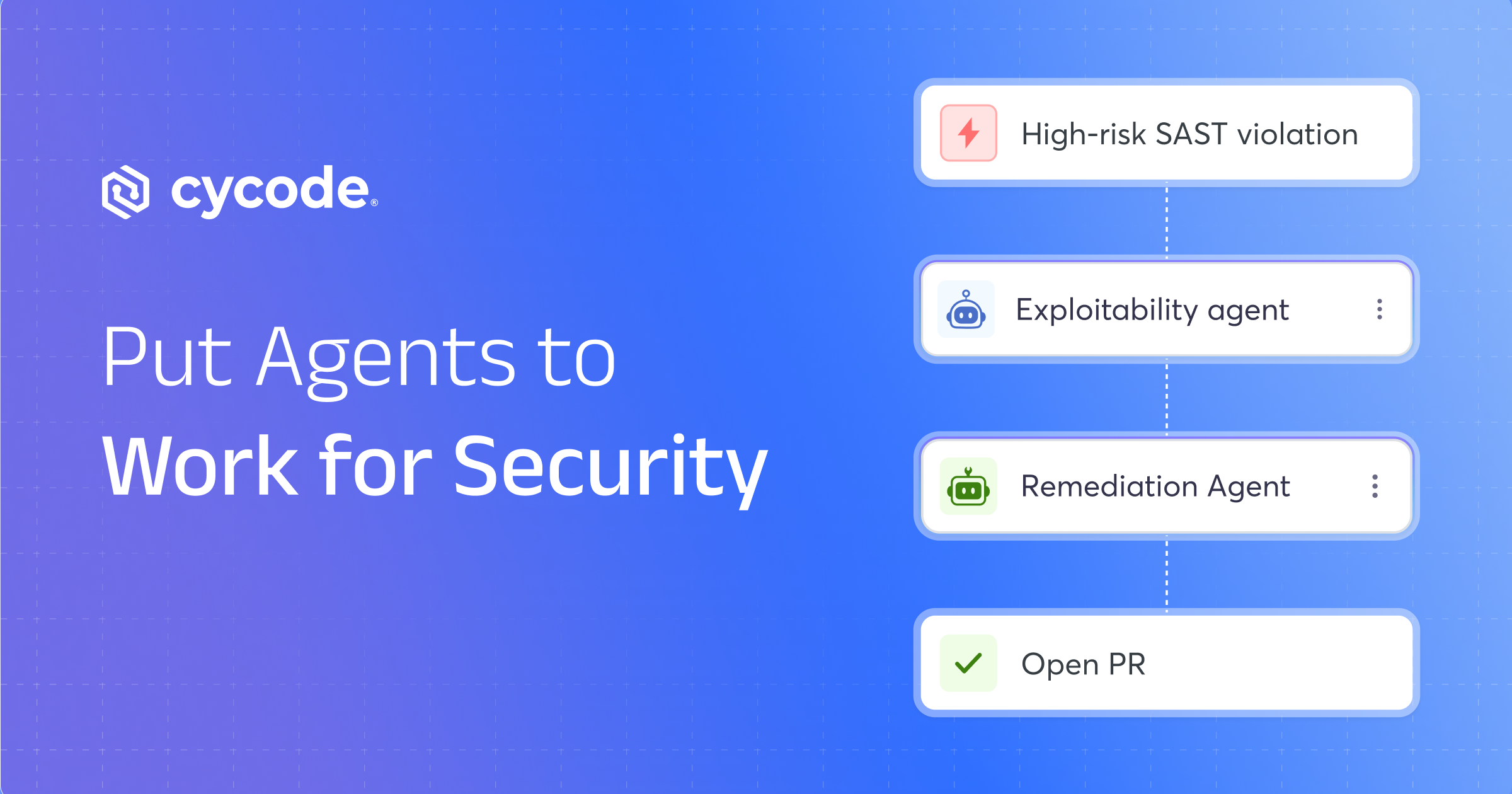
Put Agents to Work for Security
Set the triggers, define the boundaries, and build workflows that make security as agentic as development. Agents act the instant risk appears. You stay in control of every step.


See What's Possible With Agentic Workflows
Every workflow has a trigger, filters, a flow of agent actions, and controls you set. See autonomous risk management made possible.

Autonomous remediation
Filter for high-risk SAST violations in your crown-jewel applications. Analyze for exploitability. If it is exploitable, generate a fix and open a PR.

Vulnerability triage
Target specific CVEs or trigger by risk score, EPSS, and impact. Analyze for exploitability. Escalate the ones that are exploitable, suppress the ones that are not.
Backlog burndown
Point agents at your high-risk backlog. Set the scope. Analyze for exploitability and fix retroactively, so the backlog you inherited stops being your problem.
SLA escalation
When a high-risk finding misses its SLA, trigger exploitability analysis automatically and remediate the moment it is confirmed exploitable.
Exception review
A developer requests an exception on a high-risk violation. Analyze exploitability with AI first, then send a recommendation for final human review.

Container remediation
Automatically remediate fixable container findings through the rebuild flow.

From Alert, To Triaged, To Fixed
Every workflow comes down to three parts: what starts it, what does the work, and where you keep control.
Triggers & Filters
Set when a workflow triggers and what is in scope. Events, filters, and variables let you focus agents on the risks that matter most.
- Trigger on new violations, status changes, missed SLAs, and more
- Filter by over 20 variables including risk score, exploit maturity, policy, and repository
- See filter matches to confirm the scope and apply workflows retroactively to burn down your backlog

Agents & Flows
Add agents to workflows and define outcome-based next steps. Go from alert, to triaged, to fixed with no human bottleneck.
- Add AI Teammates to workflows, starting with Exploitability and Remediation agents
- Multi-agent flows where upstream outcomes trigger downstream agents
- Platform and third-party actions update violations, send alerts, and open tickets
Confidence & Control
Eliminate human constraints without surrendering human control. Set which actions require review and which happen autonomously, with confidence thresholds on every agent.
- Confidence thresholds put boundaries on agent actions
- Human review where you need it, autonomous action where you don't
- Review logs and audit trails keep everything visible and advancing
Everything A Workflow Can Do

Condition-based triggers
Fire on new violations, status changes, and missed SLAs. Respond to risk instantly and automatically, not when overworked teams have time to look into it.
60+ filter variables
Scope by policy, repository, vulnerability, exploit maturity, EPSS, and more, so agents focus on what matters.
Multi-agent chaining
Create flows where the outcomes of one agent trigger downstream actions by another. Analyze for exploitability. Fix if exploitable. Suppress if not.
Confidence thresholds
Set the confidence thresholds agents need before they act. Control what runs autonomously and what requires human review.
Human controls at any step
Calibrate reviews to minimize constraints without surrendering control. Start with stricter reviews and adjust them as agents earn trust.
Auditable decision traces
Every run records what triggered it, what each agent did, and which boundary applied.
Risk reduction at scale
Leverage workflows to triage and burndown your backlog, analyze exception proposals, address missed SLAs, and manage risk at machine speed.
Token efficiency
Filters focus agent effort and tokens on issues that matter. Loop detection & caching prevent duplicate tasks and improve efficiency.
Human-Driven & Agent-Assisted
- A person has to notice the event first
- A person invokes each agent by hand
- A person passes output to the next step
- Security tops out at human speed
Agent-Driven & Human-Controlled
- The workflow fires the moment risk appears
- Agents assess, chain, and act on their own
- You decide which actions need review
- Security keeps pace with development
Questions Security Teams Ask
Does this remove humans from security decisions?
Is an Agentic Workflow just automation with an AI label?
What stops a workflow from taking the wrong action?
How do I keep this from burning my token budget?
Explore Agentic Security
Agentic development changed how software gets built. Agentic security changes how it stays safe. See how Cycode makes security as agentic as development, so risk is found, understood, and resolved at machine speed, inside the boundaries you control.

